
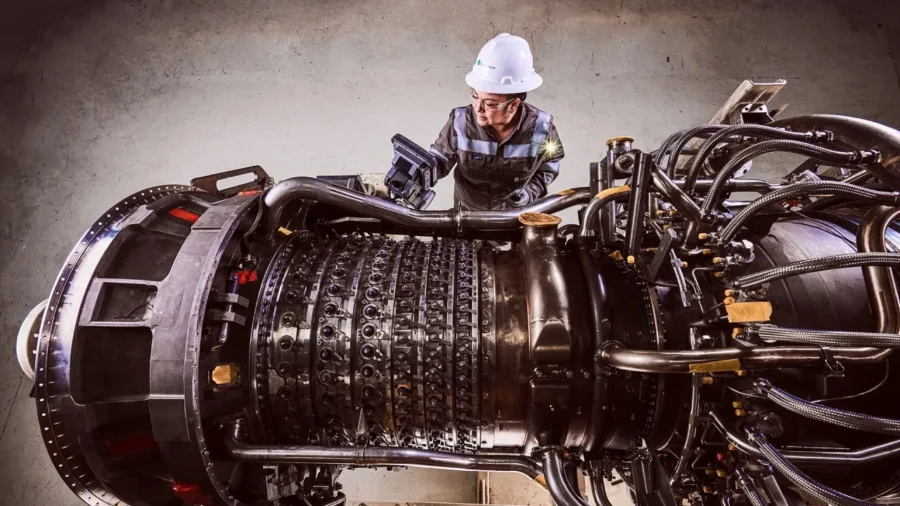
As AI data centers grow, the pressure on electrical infrastructure is no longer limited to grid investments. Order queues for large gas turbines at the heart of natural gas power plants have lengthened, prices have risen sharply, and the most critical bottleneck of the sector has come down to the production of advanced blades used in the hot section of the turbines. It has become difficult to find gas turbines, prices have increased sharply since 2019.
One of the most striking headlines of the recent period in the energy sector has been gas turbines, which have come to the fore again with the electricity needs of artificial intelligence data centers. Large data centers are no longer satisfied with just drawing electricity from the grid; in some projects, a natural gas power plant is installed directly next to the facility. This table has pushed order queues forward several years in the large gas turbine market, which already has limited production capacity.
According to the latest data from Wood Mackenzie, gas turbine prices are expected to rise to $ 600 per kW by the end of 2027. This means an increase of 195 percent compared to 2019. The same report states that global gas turbine orders reached 110 GW by the end of 2025, while global production capacity remains in the 60-70 GW band. This difference changes the mathematics of energy investments. In combined cycle power plants, gas turbines account for approximately 20 to 30 percent of the project cost.
This share goes even higher in simple cycle power plants. For this reason, turbine price and delivery time are no longer just a technical detail in power plant projects, but have become one of the main items that determine the schedule and feasibility of the investment. The order queue is not felt only on the price side. According to industry data cited by Reuters, delivery times for large gas turbines can exceed five years.
Gas power plant capacity planned or under development in the USA increased to 252 GW in 2025. Although not all of this capacity will be put into operation, the increase in demand is rapidly filling the delivery schedule of manufacturers. At the center of the market is the trio of GE Vernova, Siemens Energy and Mitsubishi Heavy Industries/Mitsubishi Power. Global Energy Monitor data shows that these three groups have a share of over 75 percent of gas power plant projects under development with a named producer.
The same data set reveals that manufacturer order queues extend until 2030. On the GE Vernova front, the picture is quite clear. The company announced that Gas Power equipment backlog and slot reservation agreements increased from 83 GW to 100 GW in the first quarter of 2026. The company expects this figure to reach at least 110 GW by the end of the year. It was announced that GE Vernova reached a volume of orders for electrical equipment for data centers in the same period, exceeding the entire last year.
Siemens Energy is also experiencing a similar wave of demand. In the company’s first quarter results of the 2026 fiscal year, the total order backlog reached a new record level with 146 billion euros. The company announced that the strong market momentum in energy production and distribution continues. On Mitsubishi Power’s side, it is clearly seen that data center-oriented demand is challenging turbine manufacturers.
The company states that data center energy demand in the USA may increase to 325 to 580 TWh by 2028, which corresponds to a production capacity of 74 to 132 GW. According to Mitsubishi Power, the power needs of modern hyperscale data centers can range from 50-100 MW to several GW, and at this scale, gas turbines stand out due to their high power density, efficiency and reliability. The real critical part of this story lies in the hot section components working inside, rather than the huge body of the turbine visible from the outside.
According to Utility Dive’s assessment based on Wood Mackenzie, the industry’s critical bottleneck is hot section components, including single-crystal blade production. These precision manufacturing processes can only be done on a large scale by a limited number of suppliers worldwide. Gas turbine blades are no ordinary metal parts. These parts work under the pressure of high temperature, high pressure, strong centrifugal loads, vibration and long working life.
In the study published by NASA on gas turbine materials, it is stated that single crystal nickel-based superalloys, thermal barrier coatings and cooling technologies play a critical role in the increase in turbine operating temperatures, although blade alloy temperatures approach melting points. Therefore, there is a big difference between copying the shape of the turbine blade and producing that blade with the same life, the same temperature resistance and the same reliability.
The geometry of the wing is only the visible part. The main thing is that the composition of the nickel-based superalloy, single crystal or directed solidification technique, heat treatment, thermal barrier coating, root processing, cooling holes and quality tests can be done at the same level. The production process shared by TEI in Turkey within the scope of the CRYSTAL project clearly shows this chain. Single crystal and oriented solidification casting, heat treatment, thermal barrier coating, root processing and opening of cooling holes are critical steps in the production of these parts.
It is known that China has also learned from Russian designs and foreign engine technologies in aviation engines for many years. However, reliability, material science, testing infrastructure and mass production quality are not improving at the same pace. The report of the China Aerospace Studies Institute within the US Air University states that China has difficulties in producing fan blades and fuselages that can withstand high temperatures and pressure in modern aero-engines, and that basic material science research is seen as one of the critical deficiencies in this field.
In the same report, it is stated that China had to learn dozens of new materials and techniques in the WS-10 program, that there were problems in the testing processes, and that lightweight, high-temperature resistant materials in turbine blades are one of the key technologies of modern engines. There is a similar structure in today’s gas turbine crisis. It’s not just a matter of building more factories. Large forgings, hot section components, single crystal fins, ceramic coatings, the supply chain, qualified workforce, testing processes and long-term service network have to grow together.
Manufacturers such as Siemens Energy, GE Vernova and Mitsubishi are increasing capacity; However, this increase does not eliminate all the pressure on the market in a short time. Industry experts speaking to Reuters also state that increasing production capacity is not as simple as it seems and that it will take time. The energy demand on the artificial intelligence side has made this pressure more visible. According to the International Energy Agency, global data center electricity consumption will double to approximately 945 TWh by 2030.
Data center electricity consumption will grow by approximately 15 percent annually in the 2024-2030 period. This rate is more than four times the total increase in electricity consumption in other sectors. Data supported by the US Department of Energy also shows that data centers in the USA use 4.4 percent of the total electricity in 2023, and this share may increase to 6.7 percent to 12 percent in 2028. This table shows that the artificial intelligence race is not only experienced on the GPU, data center and software side.
Electricity generation, grid connections, turbine production and materials science are now part of the same chain. A new data center campus could be planned within a few years. However, the delivery schedule for the large gas turbine that will feed it may extend to 2029-2030. A chip is required for model training, a data center is required for the chip, continuous electricity is required for the data center, and large-scale production capacity is required in most projects for continuous electricity.
For gas turbines, which are one of the most critical links in this chain, the issue is not only ordering, but also getting decades of metallurgical, production and testing experience to the field on time.






Comments
You can write your views about this story. Comments may be moderated according to site settings.