
French AI company Mistral is putting Europe’s artificial intelligence debate into sharper focus as it defends military uses of AI while expanding the data center infrastructure needed to support larger models and enterprise systems.
The company’s position highlights a question Europe is increasingly forced to answer: can it build competitive AI systems without relying too heavily on U.S. and Chinese technology platforms?
Mistral CEO Arthur Mensch defended the use of AI in defense contexts while announcing a new data center in Les Ulis, France, according to Reuters. Mensch argued that Europe must develop its own AI tools because global rivals are already using the technology.
That argument places Mistral at the center of a sensitive policy debate. AI is becoming more important in cybersecurity, intelligence analysis, logistics, battlefield awareness and defense planning. But military AI also raises concerns about oversight, accountability, escalation and the risk of automation being used in high-stakes decisions.
For Mistral, the issue is also commercial and strategic. The company has positioned itself as a European alternative to larger U.S. AI firms. That matters because governments and companies across Europe are looking for local AI providers that can offer advanced models while keeping data, infrastructure and regulatory control closer to home.
Reuters reported that Mistral supplies the French military and has added Airbus as a client across commercial, defense and space sectors. The company’s valuation reached €11.7 billion in 2025, making it one of Europe’s most closely watched AI startups.
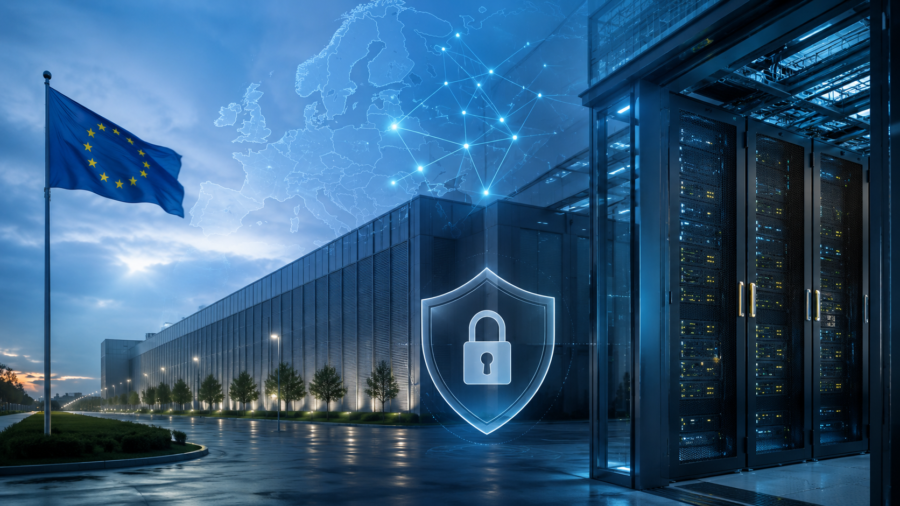
The data center expansion is just as important as the military AI debate. Mistral plans to scale its computing infrastructure to 200 megawatts by the end of 2027 and 1 gigawatt by 2030, Reuters reported. The new French site will complement existing locations in Sweden and France.
That scale shows how AI competition is becoming a physical infrastructure race. Building advanced models requires large amounts of computing power, energy, cooling, networking and specialized hardware. Companies that cannot secure enough compute may struggle to keep pace with rivals.
For Europe, this creates a difficult balance. Policymakers want AI innovation, local champions and technological independence. At the same time, new data centers can raise concerns about energy use, local environmental impact and public trust.
Mistral’s expansion therefore touches two of the biggest AI questions at once: who controls the technology, and what infrastructure is needed to run it?
The military angle makes the debate more complicated. Some European leaders argue that defense AI is necessary because adversaries will not wait for perfect global rules. Critics worry that military adoption could move faster than regulation, especially if companies and governments treat AI capability as a strategic race.
Mensch’s comments came in response to criticism from Pope Leo, who recently called for global regulation and warned against military use of AI, according to Reuters.
That contrast captures the broader tension around AI. One side sees advanced AI as a tool Europe must build to protect its sovereignty and security. The other side warns that military AI could create ethical and safety risks that are difficult to reverse once systems are deployed.
For ordinary users, the debate may seem distant. But the outcome could shape the AI tools used in public services, companies, defense industries and regulated sectors. If Europe succeeds in building strong local AI infrastructure, businesses and governments may have more alternatives to U.S. cloud and model providers.
If Europe falls behind, it may remain dependent on outside technology for systems that affect security, industry and public administration.
There is also a business angle. Mistral’s growth shows that AI competition is no longer limited to consumer chatbots. Enterprise contracts, defense partnerships, cloud capacity and sovereign AI platforms may become the next major battleground.
For startups, that means success may depend not only on model quality, but also on trust, regulatory alignment and access to compute. A company that can offer local infrastructure, transparent governance and strong performance may have an advantage in Europe’s public and industrial markets.
The risk is that the same sovereignty argument can be used to justify rapid deployment before the public has fully debated the consequences. That is especially true in defense, where secrecy can limit outside scrutiny.
Mistral’s latest move does not settle the argument. It shows how fast the debate is moving.
Europe wants to be more than a customer in the AI era. Mistral is trying to become one of the companies that makes that possible. But as AI enters defense and data center expansion accelerates, the question is not only whether Europe can build its own AI systems.
It is whether it can build them in a way that earns public trust.






Comments
You can write your views about this story. Comments may be moderated according to site settings.