
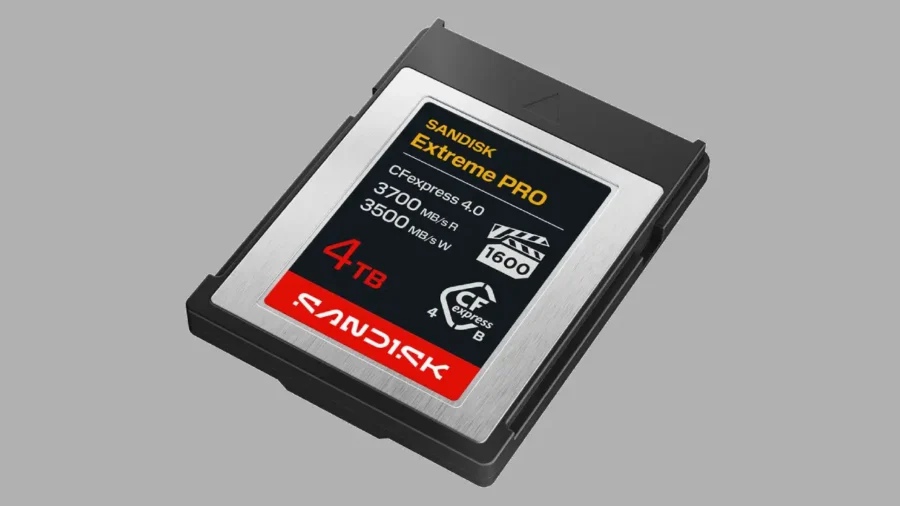
Summary in 10 Seconds: The new series comes with six different capacities, from 128 GB to 4 TB. Up to 3700 MB/s reading and 3500 MB/s writing values are shared for all models. 1 TB-4 TB models come with VPG1600 support; The lower capacities include VPG800 and VPG400 information. US store pages show prices of $499.99 for 400GB, $899.99 for 1TB, $1,199.99 for 2TB, and $1,799.99 for 4TB. SanDisk announced its new Extreme PRO CFexpress 4.0 Type B memory cards for the professional camera side.
The new series comes with 128 GB, 256 GB, 400 GB, 1 TB, 2 TB and 4 TB capacity options. The common table of cards includes reading speeds of up to 3700 MB/s and writing speeds of up to 3500 MB/s. The company fits this series directly into 4K, 6K, 8K and 12K shooting workflows. The real highlight here isn’t just the peak speed. For 2 TB and 4 TB models, the minimum continuous write speed increases to 3100 MB/s. This value is given as 1950 MB/sec for the 1 TB model, and 900 MB/sec for models between 128 GB and 400 GB.
In other words, although the series is grouped under a single name, especially the upper capacities draw a much stronger profile for long-term high bit rate recording. The real difference emerges in long shooting. Since the CFexpress 4.0 standard has moved to the PCIe Gen4 base, it can offer twice the bandwidth on the theoretical transfer side compared to the previous CFexpress 2.0 generation. SanDisk’s new cards also come with 3700 MB/s reading and 3500 MB/s writing values, which are close to the limits of this new standard.
This picture on paper directly affects the card blanking time and the workflow after high-resolution recording. But in professional use, it is not only the highest speed value that is decisive. Minimum sustained write speed is much more critical to avoid frame drops during long-term recording. SanDisk clearly highlights the upper capacities here. While the 2 TB and 4 TB models offer a minimum continuous writing of 3100 MB / s, the 1 TB model remains at 1950 MB / s.
For 128 GB, 256 GB and 400 GB options, the minimum continuous writing is listed as 900 MB/sec. This makes especially the 2 TB and 4 TB versions of the series more attractive for serious video production works. The 12K emphasis and VPG1600 detail are important. The company positions the new series directly for video recording up to 12K. In addition, VPG1600 support is provided in 1 TB, 2 TB and 4 TB models. For lower capacities, VPG800 and VPG400 information is shared.
In short, there is a single memory card family here, but the usage scenario varies significantly depending on capacity. For those who make long-term recordings with high-end bodies, models of 1 TB and above seem more meaningful. SanDisk also highlights SmartIdle technology. According to the information provided by the company, the card switches to low power mode when compatible cameras are idle, reducing energy consumption and trying to balance the heating side.
This detail can be especially important on long shooting days and in hot working environments. Not only fast, but also in professional class on the physical side. The target audience of the cards is shown to be professionals using cinema cameras, mirrorless cameras and CFexpress Type B card readers. The technical table includes drop resistance information up to 5 meters for all models. A limited lifetime warranty is offered on the entire series.
In the technical summary of the 128 GB, 256 GB and 400 GB models, weight information of 9.5 grams is also shared. On the price side, the product family clearly plays into the professional segment. On US product pages, the 400 GB model appears as $499.99, the 1 TB model at $899.99, the 2 TB model at $1,199.99, and the 4 TB model at $1,799.99. Additionally, the phrase Notify Me also appears on the same pages. So, although prices have started to appear, the large-scale sales schedule of all variants is not yet completely clear.






Comments
You can write your views about this story. Comments may be moderated according to site settings.