
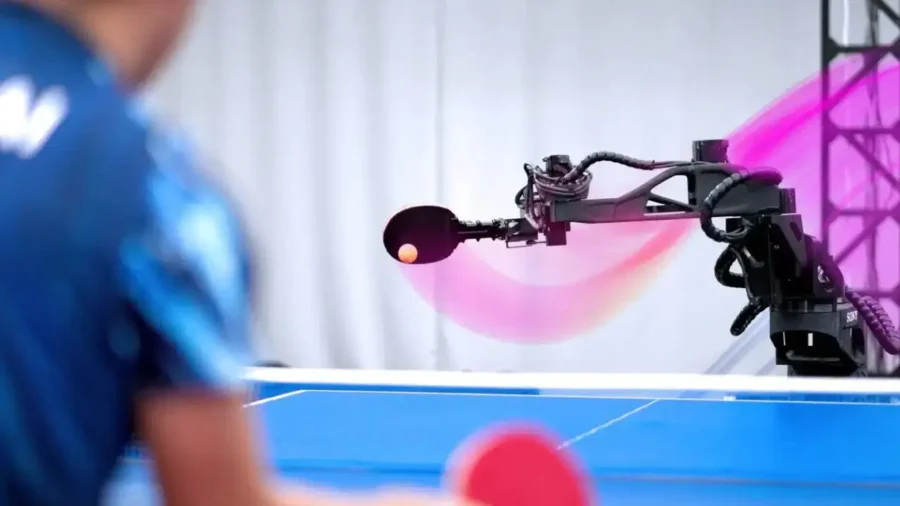
Ace, the autonomous table tennis robot developed by Sony’s artificial intelligence research unit, crossed an important threshold by competing against high-level human players in Tokyo. Ace defeated elite level players and won against professional players in matches played under the rules of the International Table Tennis Federation and managed by licensed referees. The robot developed by Sony AI is considered to be the first robot to reach the expert level in table tennis with its fast perception system, artificial intelligence-based control algorithm and advanced robotic equipment.
Details of the project were shared in the study published in Nature magazine. Ace, signed by Sony AI, reached the expert level against human opponents in table tennis. Table tennis-playing robots have been developed in different forms since 1983. However, until now, these systems have not been able to truly compete with high-level human players. This is where Ace made the difference. The robot played against elite and professional table tennis players in the matches held in Tokyo and won some matches.
Sony AI Zurich Director and Project Ace leader Peter Dürr stated that table tennis is still a challenging field for artificial intelligence and robotics. According to Dürr, artificial intelligence systems have managed to surpass human experts in digital fields such as chess, Go and video games. However, in physical and real-time sports such as table tennis, the situation is much more complicated. Because in such sports, the robot must instantly detect the ball, predict the opponent’s move, make decisions in a fraction of a second and physically make the correct shot.
The purpose of developing Ace is not to make a robot that only plays table tennis. With this project, Sony AI is investigating how robots can perceive, plan and physically react in dynamic environments with human-like speed and precision. Dürr said that Ace’s perception system and learning-based control algorithm offer techniques that can be used in critical physical areas in terms of production, service robots, sports, entertainment and security.
According to the matches in the study published in Nature, Ace won three of the five matches it played against elite-level players in April 2025. He lost two matches against professional players in the same period. According to Sony AI, the robot later defeated professional players in December 2025 and last month. The main factor that enabled Ace to reach this level in table tennis is its ability to follow the ball very quickly and precisely.
The robot’s architecture includes nine synchronized cameras and three different vision systems. These systems follow the ball that comes at high speed and carries spin. Dürr stated that this speed is at a level that captures movements that would appear blurry to the human eye. The physical structure of the robot was also specially developed. Researchers prepared a special eight-joint robot platform for Ace. According to Dürr, this structure meets the minimum level required for competitive table tennis shots.
Three of these joints control the position of the racket, two control the direction of the racket, and three control the speed and power of the hit. The main factors that make table tennis difficult for robotics are the speed, rotation and constantly changing trajectory of the ball. The opponent’s hitting style, the ball’s contact angle with the table and the amount of spin change in each position. Therefore, it is not enough for the robot to just be fast; At the same time, he needs to instantly adapt to the opponent’s game.
Ace showed a strong performance in this field, but the adaptability of professional players is still a significant advantage. Professional table tennis player Mayuka Taira lost her match against Ace in December. In his evaluation shared by Sony AI, Taira said that one of the robot’s greatest strengths is that it is very difficult to predict. According to Taira, since Ace does not show any emotion, the player cannot read which shots the robot is having difficulty with or which balls it does not like.
This makes it more difficult to play against. Elite player Rui Takenaka, who experienced both wins and losses against Ace, drew attention to the robot’s serve returns. Takenaka said that in complex spin serves, Ace sends the ball back with complex spin and this makes the game difficult. However, he stated that in simpler services, called knuckles, the robot returns simpler balls, thus providing an opportunity to attack in the third shot.
Peter Dürr said Ace has superhuman abilities in reading the spin of incoming balls and reaction time. Since the robot is trained by learning on its own in a simulation environment, rather than by watching human players, it can react differently than humans and create positions that surprise its opponents. Despite this, Ace has areas that need improvement. According to Dürr, professional human athletes are very strong at finding the opponent’s weak points and adapting to them in the game.
The Sony AI team continues to work to improve Ace’s adaptability. Ace’s success shows that robots have reached a new level not only in controlled laboratory environments, but also in competitive fields that require quick decisions and precise physical movement. This development in table tennis sets an important example for robotic technologies that can be used in different areas, from production lines to service robots, from entertainment applications to safety-critical physical systems.




Comments
You can write your views about this story. Comments may be moderated according to site settings.