
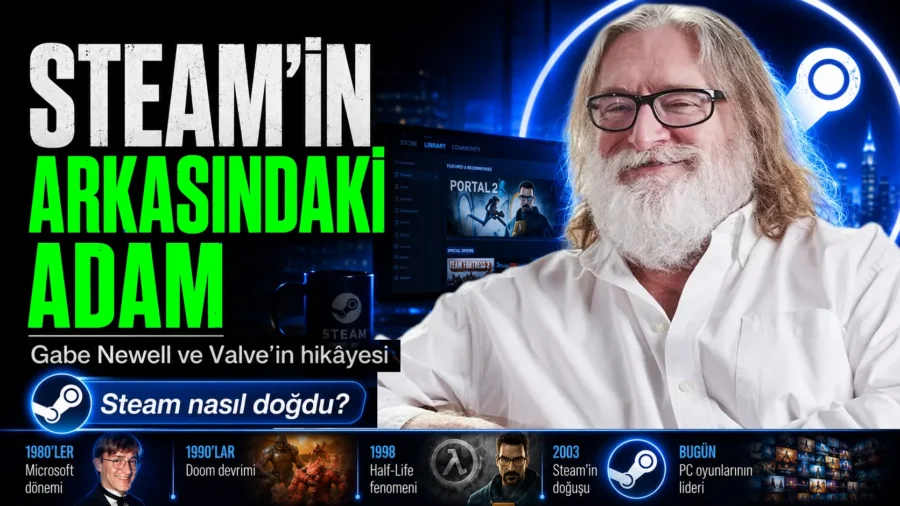
When it comes to PC gaming, one of the first platforms that comes to mind is Steam. However, Steam’s story is not limited to digital game sales. At the center of this story; There’s Gabe Newell, who dropped out of Harvard, worked at Microsoft on the early days of Windows, and later founded Valve, revolutionizing PC game distribution. Who is Gabe Newell? Gabe Logan Newell was born in 1962 in Colorado, USA. Newell, who was interested in computers and software at a young age, entered Harvard University, but stepped into the world of technology before completing his education.
This choice completely changed the direction of his career. Newell joined Microsoft and worked at the company for nearly 13 years. During this period, he took part in the first major versions of Windows. During the years when Microsoft was rapidly growing in the personal computer market, he directly observed how an operating system turned into a platform. This experience became one of the important parts of the mindset that would later form the foundations of Steam.
The years spent at Microsoft were like school for Gabe Newell. The years spent at Microsoft did not only teach Gabe Newell how to develop software. It also showed how a large ecosystem was established, how developers were supported, and how user habits could be changed. Windows was one of the most important software platforms that brought computers to homes and offices at that time. Newell took part in this great transformation.
However, by the 1990s, his interest began to shift in a different direction: games. The impact of games such as Doom on PC culture showed that games were no longer just entertainment products. Gamers were upgrading their PCs for games, setting up network connections, sharing mods, and consuming software in a whole new way. For Gabe Newell, this was a strong sign that games could be one of the most important software areas of the future.
How was Valve founded? In 1996, Gabe Newell left the company along with his Microsoft colleague Mike Harrington. Using their own savings, the duo founded Valve Corporation. The establishment of Valve was a little different from the story of a classic game studio. From the beginning, the company is not like a small team that just wants to make games; It acted like a software company thinking about game technology, distribution and player experience.
Newell and Harrington’s first big target was Half-Life. At that time, the first-person shooter genre was on the rise, but Valve did not want to make a game where only enemies were shot. A stronger atmosphere, storytelling and a feeling of being truly involved in the world were aimed. The big break that came with Half-Life, released in 1998, enabled Valve to make a strong entry into the gaming world. The game redefined the first-person shooter genre not only through action, but also through storytelling and atmosphere.
The success of Half-Life quickly made Valve one of the most remarkable studios in the industry. The narrative language used in the game, scripted sequences and the design approach that constantly keeps the player in the world inspired many games in the following years. This success paved the way for Valve to leave a permanent mark on the gaming world with brands such as Counter-Strike, Portal, Team Fortress, Left 4 Dead and Dota 2.
Counter-Strike and community culture. One of Valve’s most important features was that it took its player communities seriously. Counter-Strike was one of the best examples of this. Originally appearing as a Half-Life mod, Counter-Strike has evolved over time into one of the cornerstones of modern competitive FPS culture. Valve was one of the companies that early recognized the contribution of mod developers and player communities to the gaming ecosystem.
This approach paved the way for systems such as Steam Workshop, community market and user-generated content in the future. In other words, for Valve, the player was not just a consumer. The player was also a part of producing content, extending the life of the game and increasing the value of the platform. Steam was not loved at first. Today, Steam is considered one of the most important platforms for PC gaming. But things weren’t so smooth in the beginning.
Steam emerged in 2003 as a tool for automatic updates and digital distribution for Valve games. It was severely criticized by players in its early stages. Mandatory online connection, account system and DRM-like structure were a disturbing change for the players of those years. Especially the fact that Half-Life 2 required activation via Steam created a great controversy. Players were used to physical boxed games. Connecting to a platform and verifying over the internet after purchasing a game was against the habits of the period.
But Valve was thinking long-term. Why was Steam successful? Steam’s success did not depend on a single feature. Over time, the platform has managed to gather many things that players need in one place. Steam; It combined game purchasing, automatic updates, friends list, multiplayer connections, cloud saves, achievements, community pages, mod support and big discount periods within the same ecosystem. This structure made PC gaming more accessible.
Players could store their games in their digital libraries without losing them, access their games by logging into their accounts on different computers, and did not have to deal with updates. After a while, Steam ceased to be a client that only runs Valve games. With third-party games coming to the platform, the PC became the center of digital game distribution. Valve’s impact on the gaming world. Valve continued to develop games while growing on the platform side with Steam.
Half-Life 2, Portal, Team Fortress 2, Left 4 Dead, Dota 2 and the sequels of the Counter-Strike series showed the company’s power in game design. Despite its short duration, Portal proved how intelligence and simplicity can combine in game design. Team Fortress 2 has been one of the successful examples of the long-lasting online gaming model. Dota 2 showed how strong a brand Valve could create in the field of esports and live service games.
However, Valve’s pace of releasing games slowed down over time. This situation caused players to wonder, “Doesn’t Valve make games anymore?” It also brought controversy. Especially the expectation of Half-Life 3 has become a part of internet culture over the years. Valve Time and the never-ending Half-Life 3 expectation. One of the most famous aspects of Valve is the humorous concept known as “Valve Time”. This expression is used to explain that the schedules announced by Valve often take longer than expected.
The expectation of Half-Life 3 was the biggest symbol of this. Players have waited for the continuation of the series for years. Valve remained silent on this issue for a long time. Despite this, the company showed that it had not completely forgotten the Half-Life universe with Half-Life: Alyx in 2020. Half-Life: Alyx was one of the most important examples of what a big budget and high-quality gaming experience could be like on the VR side.
Thus, although Valve has moved away from the classical game development tempo, it has again proven that it can do things that can affect the direction of the industry at the right time. PC gaming has become handheld with Steam Deck. One of Valve’s most important moves in recent years has been Steam Deck. Released in 2022, Steam Deck brought the idea of making PC games handheld to the mainstream. Thanks to SteamOS and Proton, many Windows games have become capable of running on a Linux-based portable device.
This wasn’t just a hardware success. It was also Valve’s move to move the Steam ecosystem from the desktop to the portable world. With Steam Deck OLED, the device was renewed with a better screen, more efficient operation and a stronger user experience. Today, Steam Deck is seen as one of the most effective products in the growth of the portable gaming computer market. Why is Gabe Newell important? What makes Gabe Newell important is not just the fact that he founded Valve.
The main point that makes it different is that it sees games as a software platform in the early period. Seeing how Windows grew at Microsoft, Newell realized that a similar platform logic could work in the gaming world. He raised the bar in game design with Half-Life. It changed game distribution with Steam. He brought PC gaming to portable devices with Steam Deck. From this perspective, Gabe Newell is not only a game company founder; He is one of the names that changed the infrastructure of PC gaming.
The power of Steam brought with it controversy. The success of Steam brought with it some controversy. The platform’s strong position in the PC gaming market, visibility issues for developers, revenue sharing discussions and quality control issues in the store come to the fore from time to time. It is not always easy to stand out on Steam, especially for independent developers. Having too many games on the platform can make discoverability difficult.
Despite this, Steam remains one of the strongest game stores on the PC side due to its large user base, reliable infrastructure and player habits. Result: Valve did not just make games, it changed gaming habits. The story of Gabe Newell and Valve shows how important it is to see the right change at the right time in the world of technology. Valve changed the gaming narrative with Half-Life. He grew the competitive FPS culture with Counter-Strike.
He showed his design power with games such as Portal and Left 4 Dead. Redefined digital game distribution with Steam. With Steam Deck, it made PC games handheld. If today there are hundreds of games in our Steam library, if big discount periods have become a part of the gaming culture, if independent developers can reach millions of players around the world, and if PC games can now be played on portable devices, Valve is at the center of this story.
What Gabe Newell realized years ago is still valid today: Games are not just games. Games are one of the most creative, powerful and community-oriented areas of the software world.






Comments
You can write your views about this story. Comments may be moderated according to site settings.