
Dr. Founder of Qubitrium, which developed the domestic quantum technology sent to space within the scope of SpaceX’s Transporter-16 mission. Kadir Durak stated that they aim to realize the quantum internet by establishing a network in the long term and said, “We are trying to make a quantum version of the Starlink project.” he said. Turkish companies’ efforts to develop technology for space continue unabated. Last month, the new satellites of ASELSAN and Fergani Space were successfully launched into space within the scope of SpaceX’s Transporter-16 mission from the USA.
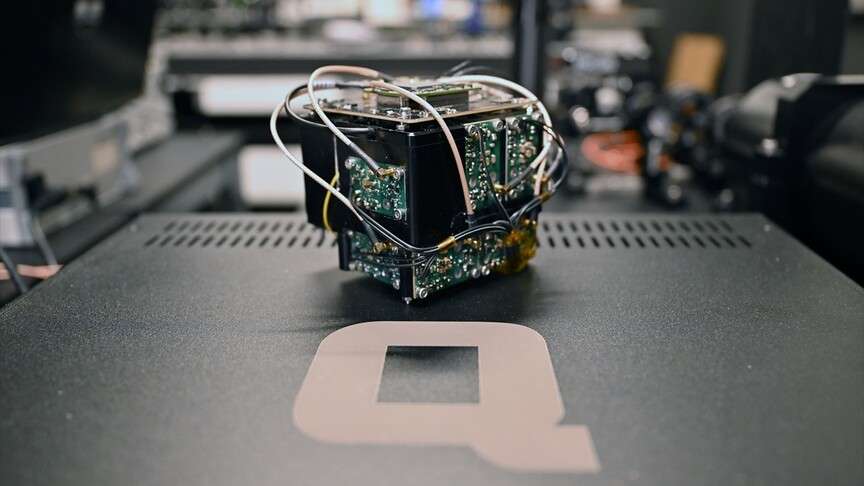
QubitCore, developed by the Turkish company Qubitrium, was among the technologies launched into space within the scope of the same mission. Designed for space-based quantum communication missions, this technology serves as a cubesat-compatible quantum key distribution system. The company, which aims to create a fast and secure communication infrastructure that is hard to break, based on quantum physics, carries out its work in its headquarters in Istanbul.
Qubitrium Founder Dr. In his statement to the AA correspondent, Kadir Durak stated that their work in the quantum field dates back to 2008 and the company was established in 2020, and said, “Our team is a very young team. We are currently 24 people. We have a branch in the Netherlands. Half of the team is my students from the university. When we do academic work, people with the abilities we want are trained. “We continue on our way with them.” he said.
Explaining that they have developed products in the fields of quantum sensing and quantum communication, Durak stated that they are also working on solutions for the field of distributed quantum computing. “We are trying to make a quantum version of the Starlink project.” Durak pointed out that space history is important for a product that works in space to be offered commercially, and said that they created the necessary reference by sending their technologies to space in this context.
Stating that they aim to establish an integrated structure in the fields of perception, communication and distributed quantum computing with the quantum internet in the next stage, Durak said, “For this, you need a source of entanglement in space. What we do is to transmit photons, that is, particles of light, to the world by operating entanglement sources in space.” he said. Stating that there are many quantum technology companies around the world, Durak said: “Unlike us, we minimize quantum technology in terms of weight, volume and electrical power need and make it commercially available for sending into space at a lower cost.
We aim to realize the quantum internet by establishing a network in the long term. The way to establish a global quantum internet is to use cube satellite technology. We are trying to make a quantum version of the Starlink project. We develop and commercialize the technologies necessary to establish the quantum internet.” Durak stated that they have recently started a new project and said, “We are developing space-based quantum memory.
We want to crown this with a launch. We aim to turn it into a commercial product like QubitCore at the end of the R&D process.” he said. “We miniaturized and combined many modules in a modular structure and sent them into space.” Referring to their collaboration with the Netherlands’ State Research Institute, Durak said, “Different research institutes see this technology as accessible and buy this technology from us.
They develop and launch their own payloads, quantum jobs.” “From now on, we have goals of launching payloads into space again, but we do not see ourselves as a company that constantly launches satellites, but as a company that launches satellites and provides quantum modules for this.” he said. Pointing out that QubitCore, which was launched into space last month, consists of 30 different submodules, Durak continued his words as follows: “There are 8 single photon detectors in QubitCore.
Normally a single photon detector is a fairly large module, weighing over 1 kilogram. Our total module is at that weight. We reduced each detector to thumb size. We miniaturized and combined many modules in a modular structure and sent them to space, and we are currently testing them all. Quantum internet won’t happen unless we make launching cost effective. “When we focus on commercial examples, we stand out in this field worldwide with our technology.” Durak stated that they cooperated with some defense companies, especially the Presidency of Defense Industries, and said, “NATO also showed interest in quantum technology and started a program called DIANA for deep technologies.
“We are one of the companies supported by NATO.” made his assessment. Cooperation with many sectors from the defense industry to telecommunications. Emphasizing that the interest in quantum technologies has increased in Turkey, Durak stated that they have developed solutions for different sectors such as defense, telecommunications, energy and finance. Durak said, “We recently signed an agreement with Türk Telekom. Our collaborations with R&D teams that want to implement quantum solutions and work on 6G continue.
We are carrying out product development-oriented studies on secure communication networks.” he said. Stating that they carried out a quantum communication demo with drones within the scope of the NATO event, Durak concluded his words as follows: “We distributed entanglement with drones. In this context, we focus on developing a technology that can be used in the field with swarm drones. Uninterrupted communication is required in the use of drones.
When the communication is interrupted, the drone can go out of control. Fiber solutions are currently used to prevent this, but this is not an ideal method. It is possible to overcome this problem with quantum communication. The quantum LIDAR project we are carrying out in the field of defense also offers a solution to this need.” Source: AA





Comments
You can write your views about this story. Comments may be moderated according to site settings.