
Hello,
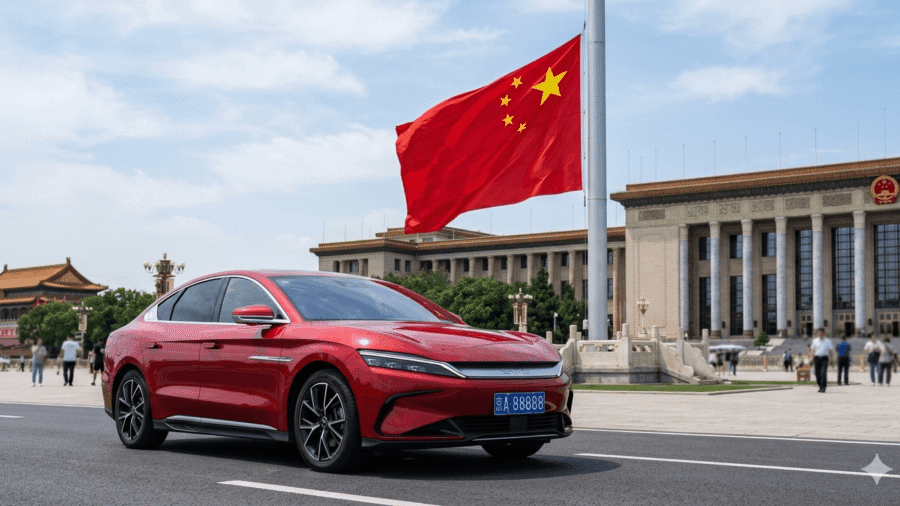
We see that the export of “zero kilometer second-hand vehicles” has been increasing rapidly in the Chinese automotive industry in the last two years. This situation draws attention in terms of both global trade balances and the internal dynamics of the sector. Moreover, today’s tension with Iran also provides an opportunity for this action. There are increasing reports that some automobile dealers operating in China benefit from tax advantages by exporting never-used vehicles abroad as “second-hand” status. Thus, Chinese companies gain the advantage of not only receiving tax refunds granted to second-hand vehicle exports, but also avoiding tax burdens in the domestic market.
Why do we say this? Although growth in the Chinese economy reached 5% last year, there is a slowdown. Weak domestic consumption is another reason. In particular, battery electric vehicle (BEV) manufacturers cannot find sufficient domestic demand despite the new generation vehicle (NEV) production capacity, which has increased rapidly in recent years to 35 million units annually. Capacity occupancy barely reaches P’s. The resulting excess supply directs automobile manufacturers to export. Cheap Chinese electric and hybrid vehicles are flooding into markets such as Europe, Southeast Asia and Latin America, putting pressure on local manufacturers. As a matter of fact, exports increased by 0% last year, reaching 2.62 million units.
In response to these developments, the United States began to impose 0 customs duty on (NEV) type vehicles imported from China. The European Union increased this rate to 45 percent. However, second-hand vehicles are relatively less affected by these high tariffs. This situation created a significant “gap” for Chinese manufacturers and exporters and encouraged the export of zero kilometer vehicles as second-hand.
The Chinese government has allowed the export of second-hand vehicles since 2019. In 2023, the number of vehicles exported in this context reached 275 thousand. The fact that more than 60 percent of these vehicles are actually zero kilometers is striking in terms of the scale of the application. Statistics say that second-hand vehicle exports will exceed 436 thousand in 2024 and 500 thousand in 2025. These vehicles mainly go to the Russian, Central Asian and Middle Eastern markets. Entry to Russia, especially through countries with low customs taxes such as Kyrgyzstan and Kazakhstan, is one of the notable trade routes.
This situation has begun to cause concern in some countries. The rapid spread of Chinese new-km second-hand vehicles in the Russian market seems to bring wider problems for the global automotive industry in the long term. As a matter of fact, countries such as Russia and Jordan have started to impose restrictions on zero kilometer second-hand vehicles. Russia banned such imports of brands that have official distributors in the country. Other relevant countries are taking similar measures.
The incentives and capacity-increasing policies provided by the Chinese state to electric vehicle manufacturers continue to further fuel this competition and make companies look for alternative solutions. Exporting zero kilometer vehicles as second-hand vehicles was a “creative” but controversial solution in this context. However, it should not be forgotten that in the long term, it may bring mergers, bankruptcies and serious restructurings in the sector.
On the other hand, this practice also has negative effects. As new vehicles are sold as second-hand, they damage brand value. When after-sales and warranty services are disrupted, consumer dissatisfaction arises. In addition, this system has risks such as inflating sales figures and gaining unfair profits from incentives.
As a result, although China’s zero kilometer second-hand vehicle exports offer a solution to eliminate excess supply in the short term, it will continue to raise serious question marks in terms of both global trade balances and the sustainability of the sector.





Comments
You can write your views about this story. Comments may be moderated according to site settings.