
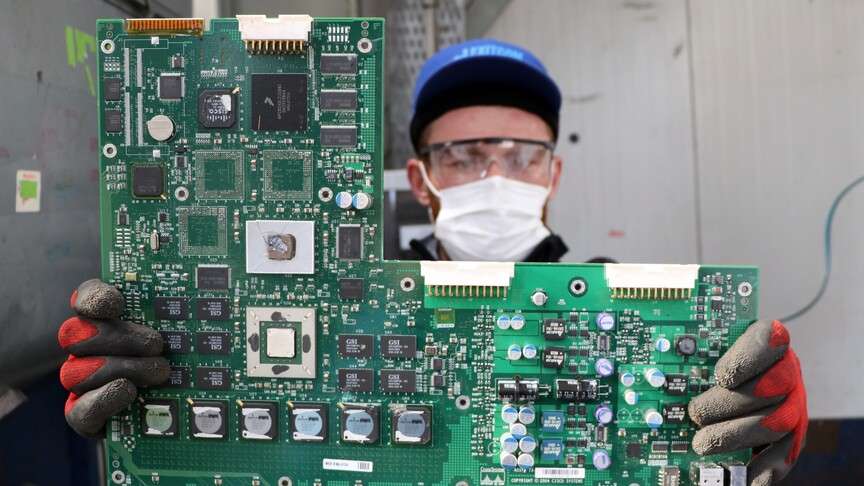
Experts stated that precious metals such as gold, silver, copper, palladium and nickel used in old electronic devices are recycled and warned that unused devices such as old mobile phones, tablets and computers should not be thrown away or kept at home in order to both benefit the economy and protect nature. ITU Zero Waste Institute Director Assoc. Dr. In his evaluation to the AA correspondent, Börte Köse Mutlu drew attention to the importance of recycling in terms of efficient use of resources.
Pointing out that tons of waste are collected every day, Mutlu said that these wastes, which take up a lot of space, mix with nature when they are not stored regularly, and from there they reach the environment and people through the food chain. Stating that precious metals such as gold, silver, copper, palladium and nickel used in electronic devices are recycled and brought into the country’s economy, Mutlu said, “The brand, model and production year of the phone may change, but 25-35 milligrams of gold are extracted from a phone.
If we want to express it more clearly, we collected 1 million phones, and an average of 35 kilos of gold are extracted from them.” When we look at our annual waste production, we are talking about a serious percentage that cannot return to the economy. This is the case all over the world. We have not been able to establish a complete cycle system. Here, we first need to increase our success rate in the collection and separation part.” he said.
Mutlu noted the following regarding the recycling process: “It is not a process like we suddenly pull out a piece of gold by hand. Very complex structures. There are many different types of electronic waste (e-waste). Even if we talk about a single phone, we need to follow 4 steps for recovery. The most important of these steps is to collect and classify electronic waste. This is the step that seems simple but reduces the overall efficiency and needs to be focused on.
There are licensed organizations when electronic waste is collected, they process it. Citizens can give them to drop-off stations. It is not possible for people to make this transformation themselves. If we recover all of these, instead of mining again, this will be achieved in this way. Social benefits are provided to the country’s economy, the country’s energy and raw material independence, and the environment is benefited.
“There are economic incentive systems for citizens, and these are also being developed.” Emphasis on “Zero Waste” Mutlu emphasized that there are great economic losses due to old electronic products not being recycled and said, “For our country, when these are collected 100 percent and urban mining is done, an income of approximately 1 billion euros is obtained. Since this is not happening right now, we can see 1 billion euros as equivalent to an economic loss.
When we consider this loss as a sector, we are talking about a price equivalent to approximately 1 million tourists coming in the summer and contributing to the country’s economy. That’s why it’s important. Of course, first of all, we say ‘environment’ before the economy, we say ‘zero waste’ first.” made his assessment. Stating that only 20 percent of electronic waste is recycled worldwide, Mutlu said, “It is possible to raise awareness among our people and collect e-waste systematically with the incentive systems of the state and private organizations, and we will make this completely widespread very soon.
Recovery and refining processes must be carried out by experts. There are risks of accidents and health problems due to the presence of chemicals that need to be used carefully and the possibility of hazardous gas and liquid wastes that may be released during the processes. “It is necessary to stay away from individual recycling efforts and contribute to the system.” he said. Assoc. Dr. Mutlu also drew attention to the work carried out in line with the Zero Waste Movement initiated by President Recep Tayyip Erdoğan’s wife, Emine Erdoğan.
“It becomes the second raw material” Dr. Energy Engineer at Okan University Faculty of Art, Design and Architecture. Lecturer Member Sevil Alp emphasized that there are 1 million tons of electronic waste in Turkey, but most of it is not registered and cannot be recycled. Stating that 1 billion euros of damage occurs annually when this waste is collected irregularly and left in homes and warehouses, Alp said: “They think, ‘What value can a single phone have?’, but when we think collectively, in tons, this is a huge economic value.
These are used in industry, defense industry and advanced technology. Once we arrive in the country with these devices, they become resources in our hands. We will either manage and use it with the right systems, or we will remove it from the economic wheel by keeping it in homes and garbage. These precious metals actually become the ‘second raw material’, they become a resource waiting in our homes. Unfortunately, they do not benefit the economy unless they are used.
“These waiting metals add great value when they enter the industry.” he said. “We call what we do ‘surface mining’.” Zekican Gündüz, who works as a facility manager at Akademi Çevre Entegre Waste Management Industry Inc., one of the places where electronic waste is recycled into the economy, stated that precious metals are found in electronic cards, processors and hard disks in old devices. Gündüz explained the process of obtaining precious metals from the recycled devices as follows: “After the waste arrives, it is separated according to its classes.
Then the plastic parts on these cards are separated and then go to the refinery. In the refinery, after the physical pre-crushing process, melting is done in the furnaces. When approximately 1 ton of electronic cards is melted, approximately 300 kilograms of metal is obtained and it is put into suitable molds. Most of this metal consists of copper. It is then chemically processed. Other metals accumulate in the part we call electronic sludge.
We obtain precious metals such as gold and silver separately using chemical methods and sites. “The products from here are shipped to the industry and to be reintroduced to the economy.” Gündüz shared the information that until recently, some of the transactions were carried out abroad due to the lack of competent refineries in Turkey, but with the establishment of the infrastructure, all of these transactions can now be carried out in Turkey.
Gündüz said that people keep scrap devices in their homes because they contain their personal data or with the thought of “needing them again” and said, “This is the biggest mistake made. For reasons such as software updates, these wastes that we keep in our homes remain unusable. While it is estimated that there are approximately 1 million tons of electronic waste in Turkey, the electronic waste collected last year was only 56 thousand tons.
A large portion of it is waiting in warehouses and homes without being brought into the economy. We call what we do ‘surface mining’. When we transform 1 ton of scrap mobile phones, we obtain approximately 300 grams of gold. When you process 1 ton of soil in the mine, you can only obtain a few grams of gold. By doing this process, we both protect nature and recycle the product and use it in our industry.” he said. Source: AA




Comments
You can write your views about this story. Comments may be moderated according to site settings.