
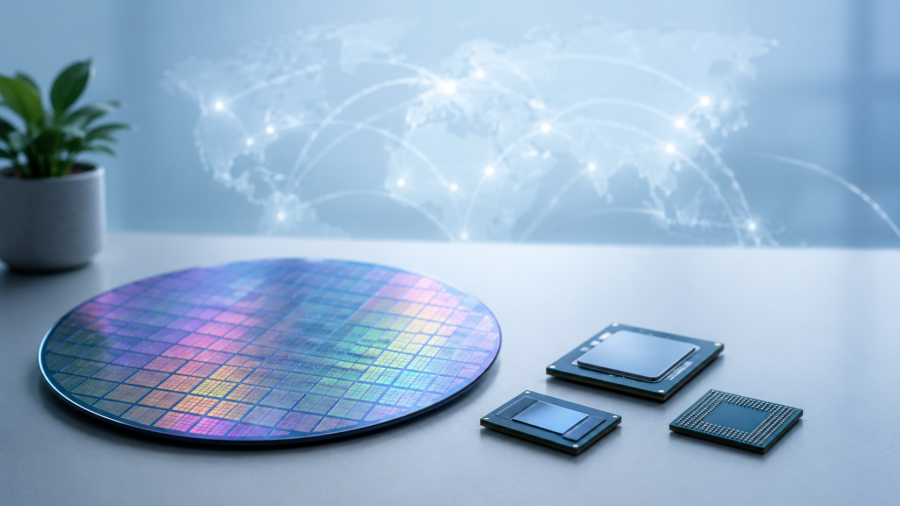
Most people know the names NVIDIA, Apple, AMD, Intel and TSMC. Far fewer people know ASML.
But inside the global chip industry, ASML is one of the most important companies in the world.
ASML does not sell phones, laptops or graphics cards. It does not make consumer AI apps. Its role is more hidden but just as critical: it builds lithography machines used by leading chipmakers to manufacture advanced semiconductors.
That matters because the AI boom depends on powerful chips. Those chips depend on advanced manufacturing. And advanced manufacturing depends heavily on lithography.
In simple terms, ASML makes some of the machines that help turn chip designs into real processors.
What ASML machines do
ASML builds lithography systems.
Lithography is the process of using light to transfer tiny circuit patterns onto silicon wafers. These patterns eventually become the transistors and connections inside a chip.
ASML says its technology gives leading chipmakers the ability to mass produce patterns on silicon, helping make computer chips smaller, faster and more energy efficient.
The most advanced ASML machines use EUV, or extreme ultraviolet lithography. ASML says EUV systems are used to print the most intricate layers on a chip, while other layers can still use older DUV systems.
That detail is important. A modern chip is not made with one tool or one step. It is built through many repeated processes. But EUV lithography is especially important for the smallest and most complex features in advanced chips.
Why TSMC depends on advanced lithography
TSMC is the world’s largest contract chipmaker. It manufactures chips designed by major technology companies.
When a company like NVIDIA designs an advanced AI chip, it usually needs a foundry such as TSMC to manufacture it at scale. TSMC then relies on a huge ecosystem of equipment suppliers, materials companies and process technologies.
ASML sits near the center of that ecosystem because lithography is one of the key steps in making leading-edge chips.
Reuters reported that TSMC is working hard to meet demand driven by the AI boom and avoid becoming a bottleneck in the chip supply chain. That pressure shows how important manufacturing capacity has become.
Demand for AI chips is not only about design talent. It is also about whether foundries have enough advanced tools, packaging capacity, materials and skilled workers to produce those chips.
Why NVIDIA is part of the same story
NVIDIA designs many of the AI accelerators used in data centers. Those chips power AI training, cloud AI tools and many of the systems behind modern generative AI.
But NVIDIA does not manufacture most of those chips itself. Its advanced chips are produced through foundry partners.
That means NVIDIA’s ability to meet AI hardware demand depends on the wider semiconductor manufacturing chain. TSMC’s capacity matters. Advanced packaging matters. Memory supply matters. Lithography capacity matters.
ASML is important because its machines help create the chip layers that make advanced processors possible.
This is why ASML can benefit from AI chip demand even though it is not an AI software company. It supplies the tools that help produce the hardware behind AI.
Reuters reported that ASML lifted its 2026 outlook on stronger AI-driven demand, with the company citing demand that continues to outpace supply.
Why EUV lithography is so hard to replace
EUV lithography is not something competitors can easily copy.
The systems are extremely complex. They require precision optics, lasers, mirrors, vacuum environments, advanced software and highly coordinated supplier networks.
ASML’s EUV systems use 13.5-nanometer light to print features that older deep ultraviolet systems cannot reach in the same way. ASML says its NXE systems are used in high-volume manufacturing of advanced logic and memory chips.
That makes EUV a key technology for leading-edge nodes.
The result is a narrow supply chain. If demand for advanced chips rises quickly, the world cannot instantly create many more EUV systems. These machines take time to build, install and qualify inside fabs.
That is one reason AI chip supply can remain tight even when companies are willing to spend more.
High-NA EUV is the next step
ASML is also developing High-NA EUV systems, the next generation of EUV lithography.
High-NA systems are designed to support even smaller and more advanced chip features. ASML says its EXE platform will support high-volume chip manufacturing for future advanced logic and memory nodes.
Reuters reported that ASML expects the first chips made with its next-generation High-NA machines to arrive within months, while the company works to address concerns about the technology’s costs.
That cost issue is important. New lithography tools can improve what chipmakers can build, but they must also make economic sense. A machine can be technically impressive and still take time to become widely used in mass production.
For chipmakers, the challenge is balancing performance, cost, yield and timing.
Why ASML affects future device prices
ASML machines are not visible to consumers, but their impact can reach consumer products.
Advanced lithography helps make powerful chips for AI servers, premium phones, laptops, graphics cards and future AI PCs. If advanced manufacturing is expensive or supply-limited, that can influence the cost and availability of high-end devices.
This does not mean ASML alone controls prices. Many factors affect product prices, including memory, packaging, labor, shipping, software, tariffs and brand strategy.
But lithography is part of the cost structure behind advanced chips.
If AI chip demand remains high and leading-edge production capacity is limited, premium hardware may stay expensive for longer. The newest AI features may also arrive first in high-end devices before reaching cheaper models.
Why governments care about ASML
ASML’s importance is not only commercial. It is also strategic.
Advanced chips are used in AI, defense, cloud computing, scientific research, smartphones and industrial systems. That makes chip manufacturing a national priority for many governments.
Because ASML builds critical equipment for leading-edge manufacturing, its technology is closely watched. Export controls and geopolitical rules can affect where the most advanced tools are sold.
This is why ASML often appears in discussions about U.S.-China technology competition, European industrial strategy and Taiwan’s role in chip manufacturing.
For readers, the simple point is this: ASML machines are so important that they are not just business tools. They are part of global technology policy.
What ordinary readers should take away
ASML matters because it builds the machines that help chipmakers manufacture the world’s most advanced semiconductors.
TSMC matters because it manufactures chips for many leading technology companies.
NVIDIA matters because its AI chips are central to today’s AI boom.
These companies are connected. NVIDIA designs AI chips. TSMC manufactures many advanced chips. ASML supplies critical lithography machines used in advanced manufacturing.
That chain helps explain why AI hardware is so hard to scale quickly. It is not enough to design a powerful processor. The industry also needs rare machines, advanced fabs, skilled engineers and a global supplier network.
The bigger takeaway
The AI race is often described as a software competition, but it is also a manufacturing competition.
Every AI model depends on hardware. Every advanced AI chip depends on semiconductor manufacturing. And semiconductor manufacturing depends on tools like ASML’s lithography systems.
That is why ASML is so important even though most consumers never see its machines.
The next time a company announces a faster AI chip or a more powerful AI laptop, the story does not begin only with the brand on the device. It begins much deeper in the supply chain, inside cleanrooms where light is used to print microscopic patterns on silicon.
ASML machines are one of the hidden reasons modern AI hardware exists at all.





Comments
You can write your views about this story. Comments may be moderated according to site settings.