
AI chips are often described as the engines behind the artificial intelligence boom. They help train large models, run cloud AI services and power the next generation of laptops, servers and smart devices.
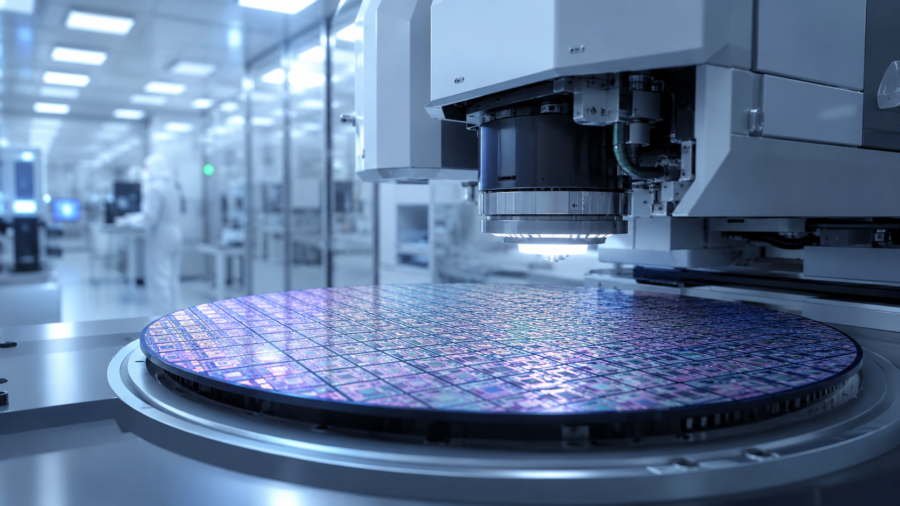
But the story does not start with the chip brand on the announcement slide. It starts inside semiconductor factories, where some of the world’s most advanced machines use light to print microscopic patterns onto silicon wafers.
Those machines are called lithography systems, and the most advanced versions are rare, expensive and extremely difficult to build.
That is one reason AI chips are so hard to make at scale. Demand for AI hardware is rising quickly, but the manufacturing tools needed for leading-edge chips cannot be produced overnight.
What lithography machines actually do
Lithography is one of the most important steps in chip manufacturing.
A chip begins on a silicon wafer. To turn that wafer into a processor, manufacturers need to create incredibly tiny circuit patterns. Lithography machines help transfer those patterns onto the wafer using light.
ASML explains that EUV lithography systems are used to print the most intricate layers on a chip. Other layers can still use older DUV systems, but the most advanced features often depend on EUV.
In simple terms, lithography is like an ultra-precise printing process for chips. But instead of printing ink on paper, it prints microscopic circuit patterns that eventually become transistors and connections.
The smaller and more accurate those patterns are, the more powerful and efficient a chip can become.
Why AI chips need advanced manufacturing
AI chips need enormous computing power.
Training and running AI models requires huge numbers of calculations. To do that efficiently, chip designers need processors with many compute units, fast memory connections and high energy efficiency.
Advanced semiconductor manufacturing helps make that possible. Smaller, denser transistor patterns allow chipmakers to fit more capability into a processor while managing power use.
This is where EUV lithography becomes important. ASML says EUV helps chipmakers continue scaling by printing some of the most complex layers inside advanced chips.
For readers, the connection is direct: AI software needs hardware, and the best hardware depends on some of the most complex manufacturing tools in the world.
Why these machines are rare
EUV lithography machines are not normal factory equipment.
They require highly specialized optics, lasers, vacuum systems, precision mechanics and software. The light itself is difficult to generate and control. The machine must align patterns at microscopic scale again and again across a wafer.
That level of precision makes the supply chain narrow. Only a small number of companies can build the most critical components, and ASML is the dominant supplier of EUV lithography systems used by leading chipmakers.
This is why the machines are rare. Demand can rise quickly, but production capacity for these tools is limited by engineering complexity, specialized suppliers and long manufacturing timelines.
A chip company cannot simply order thousands of extra EUV systems and receive them immediately. These machines take time, expertise and huge investment to produce.
Why they are so expensive
Lithography systems are expensive because they are among the most complex industrial machines ever built.
High-NA EUV systems, the next generation of EUV equipment, are even more costly. WSJ reported that TSMC has purchased ASML’s High-NA EUV machines but has not yet deployed them for mass production because of high costs. The report also noted that each machine can cost up to hundreds of millions of dollars.
That cost matters.
If the machine is extremely expensive, chipmakers must decide when it makes economic sense to use it at scale. A new tool may enable smaller and more advanced chips, but it also has to deliver enough production value to justify the investment.
TSMC’s position is especially important because it manufactures advanced chips for many major technology companies. Reuters reported that TSMC is working hard to meet AI-driven chip demand and avoid becoming a bottleneck in the supply chain.
In other words, advanced AI chip demand is not just about designing better chips. It is also about whether the manufacturing system can keep up.
Why High-NA EUV matters
High-NA EUV is the next major step in lithography.
“NA” stands for numerical aperture, which relates to how much detail the lithography system can resolve. Higher NA helps print even smaller features, which can support more advanced chip nodes in the future.
The benefit is clear: smaller and more precise features can help chipmakers continue improving performance and efficiency.
The challenge is cost and complexity. A tool may be technically impressive but still difficult to use widely if it is too expensive or if production methods need time to mature.
That is why TSMC’s cautious approach matters. The company is researching High-NA EUV while still using current EUV tools for many near-term goals. Reuters previously reported that TSMC introduced smaller, faster chip technologies without relying immediately on the pricey new ASML tool.
This shows an important truth about chip manufacturing: the newest tool is not always used everywhere right away. Chipmakers balance performance, cost, yield and timing.
Why AI demand creates pressure
AI demand is putting pressure across the semiconductor supply chain.
Data centers need more accelerators. Cloud companies need more computing capacity. Device makers want AI features in laptops, phones and workstations. Chip designers want more advanced manufacturing.
All of that demand flows back to foundries and equipment suppliers.
If advanced lithography capacity is limited, the industry must decide which chips get priority. High-margin AI accelerators may compete with smartphone processors, PC chips, automotive chips and other advanced devices for manufacturing resources.
That does not mean every consumer device will become unavailable. But it can affect pricing, production planning and how quickly new chip generations arrive.
This is why AI chips and lithography machines are now part of the same conversation.
Why this affects ordinary buyers
Most people will never see an EUV machine, but they may feel the effects indirectly.
If AI chip demand stays strong and manufacturing costs rise, future laptops, AI PCs, graphics cards and premium phones could remain expensive for longer. New features may arrive first in high-end devices before moving to cheaper products.
The same applies to cloud AI. If running AI services requires expensive hardware and limited manufacturing capacity, companies may charge more for advanced AI features or reserve them for paid plans.
This does not mean prices will definitely rise for every product. Consumer pricing depends on many factors, including competition, memory costs, software strategy and regional markets.
But lithography is one hidden reason advanced chips remain expensive. The machines that make them are rare, complex and costly.
Why ASML is so important
ASML is important because it builds the lithography tools used by the world’s leading chipmakers.
Its EUV systems help manufacture the most advanced chips. Its High-NA EUV systems are expected to support future generations of semiconductor scaling.
This gives ASML a central role in the AI hardware race, even though it does not sell consumer chips or AI apps directly.
When people talk about NVIDIA AI chips, Apple Silicon, AMD accelerators or future AI PCs, the manufacturing chain often leads back to foundries and their equipment suppliers. ASML is one of the most important names in that chain.
That does not mean ASML controls the entire chip industry alone. Chip design, foundry process technology, packaging, memory, materials and software all matter. But lithography remains one of the most critical bottlenecks.
The bigger takeaway
AI chips depend on much more than clever design.
They depend on a global manufacturing system that includes silicon wafers, cleanrooms, deposition tools, etching tools, advanced packaging and lithography machines that use light to print tiny circuit patterns.
The most advanced lithography systems are rare and expensive because they are extremely difficult to build and operate. That is why AI chip production cannot scale instantly, even when demand is huge.
For ordinary readers, the lesson is simple. The AI boom is not only a software story. It is also a hardware and manufacturing story.
Every chatbot, AI laptop, cloud model and smart device depends on physical machines inside semiconductor fabs. Lithography is one of the hidden technologies that makes those chips possible.
That is why AI chips depend on rare and expensive lithography machines, and why the companies that build and use those machines are now central to the future of technology.






Comments
You can write your views about this story. Comments may be moderated according to site settings.