
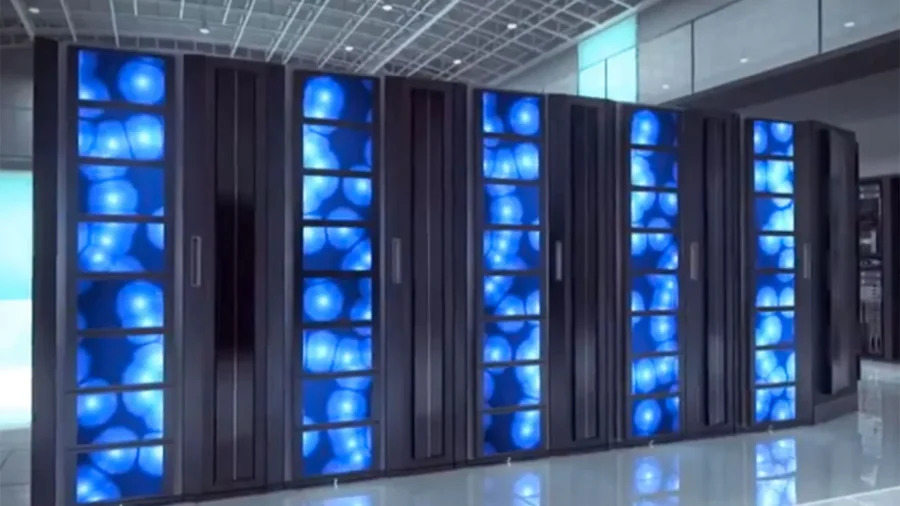
China attracted attention with its new system LineShine in the high-performance computing race. Shenzhen National Supercomputer Center announced that the new generation supercomputer, built entirely on domestic processor, storage and network technologies, targets a 2 exaflop performance level when it reaches full capacity. LineShine was introduced at a corporate meeting in Shenzhen focusing on domestic computing power and industrial applications.
The system is positioned as one of the most concrete examples of China’s plan to reduce foreign dependency. According to the center’s statement, the project is being developed for scientific computing, engineering simulations and large-scale artificial intelligence workloads. LineShine will reach the exascale level with domestic processors. Lu Yutong, Director of Shenzhen National Supercomputer Center and chief designer of LineShine, stated that the system creates an end-to-end domestic supercomputer stack with Chinese-designed chips, storage units and network technologies.
This structure means not only a machine that offers high processing power, but also a platform that is controlled in China, from hardware to network infrastructure. LineShine is being developed gradually. In the first phase, 100 Huawei Kunpeng servers are used. This section consists of a total of 12 thousand 800 CPU cores. In the second phase, the system is expanded to a much larger structure. At this stage, tens of thousands of CPUs, large-scale connection infrastructure and large storage systems designed for high-efficiency computing workloads come into play.
In the technical documents related to the project, LineShine’s distributed computing architecture is described as being based on ARM-based processors, high-bandwidth memory and high-speed connection infrastructure. According to the pre-print document shared by the researchers, LineShine consists of 20,480 computing nodes as an exascale class system developed by the Shenzhen National Supercomputer Center. There are two ARMv9-based LX2 processors in each node.
The full installation target of the system reaches 47 thousand CPU levels. This structure reveals a different approach from classical GPU-heavy Western supercomputer setups. While leading national laboratory systems in the US and many powerful machines in global rankings stand out with GPU accelerators, LineShine is introduced with a more CPU-centric architecture. LineShine’s uses include molecular simulations, fluid dynamics, material design, climate modelling, life sciences and large-scale artificial intelligence model training.
The Shenzhen center describes the system not just as a traditional scientific computing machine, but as a hybrid platform that combines artificial intelligence and engineering simulations on the same infrastructure. This approach also coincides with the broader transformation in the supercomputer world. Artificial intelligence training, physical simulations and scientific research are now increasingly running on shared infrastructures.
For this reason, LineShine does not stick to a single usage scenario; It is being developed to serve a wide range of areas, from materials research to climate calculations, from biology studies to large artificial intelligence models. Li Xiaoli from Shenzhen Science and Technology Innovation Bureau described the project as an example of full domestic control and self-sufficiency across the entire technology stack. For China, this statement is especially important at a time when restrictions on access to advanced chips are increasing.
LineShine is not a system that only seeks performance records; It is part of the country’s plan to make its high-performance computing infrastructure more independent from external supply chains. China’s move comes at a critical time in the competition between artificial intelligence and supercomputers. Access to advanced GPUs has become more complicated due to export controls and semiconductor restrictions. The development of LineShine with domestic CPUs and Chinese-designed system components stands out as a long-term infrastructure response to this pressure.
Despite this, LineShine is still in the development phase. The exact operational usage schedule of the system has not been announced. A performance level of 2 exaflops was also shared as the target expected to be achieved when the full installation is completed. Therefore, the final performance results for LineShine will become clear after all phases of the system are put into operation. LineShine shows that China is focusing not only on processing power but also on the domestic hardware ecosystem in the supercomputer race.
When the system reaches full capacity, it can become one of the country’s most ambitious computing infrastructures in the fields of science, engineering and artificial intelligence.





Comments
You can write your views about this story. Comments may be moderated according to site settings.