
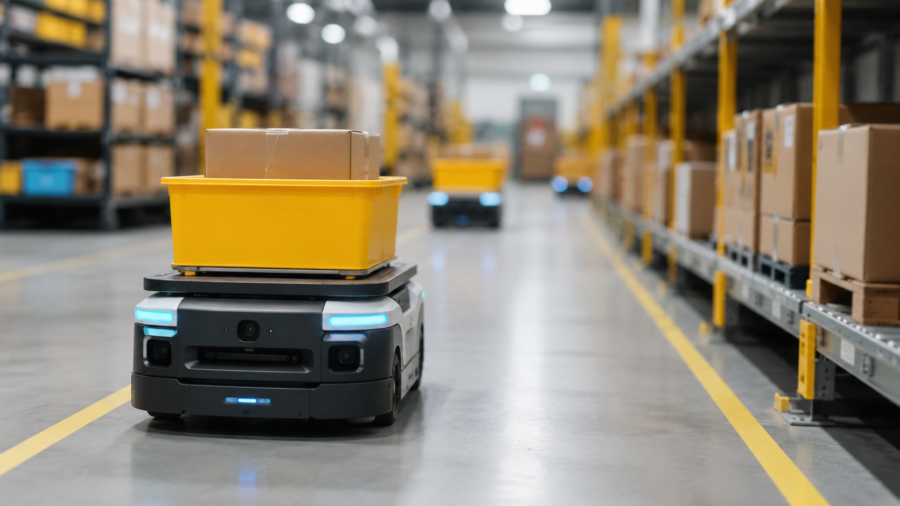
Amazon’s New AI Warehouse Robot Shows How Everyday Deliveries Are Changing
Amazon’s latest warehouse robot is not just another machine moving boxes from one place to another. It is a sign of how online shopping, delivery speed and artificial intelligence are starting to connect in more practical ways.
The company has unveiled an upgraded version of Proteus, its autonomous warehouse robot, as part of a major European logistics investment. According to Reuters, Amazon is investing about €10 billion in its European fulfillment network and plans to use new robotics systems to improve how goods move through warehouses and delivery centers.
The upgraded Proteus robot is designed to understand more natural instructions and make more decisions on its own. Instead of being limited to narrow tasks or specific dock areas, the newer version is expected to work across larger parts of warehouse floors. The Verge reported that workers can communicate with the robot using natural language, allowing it to interpret tasks without needing specialized code.
For ordinary shoppers, this may sound distant. Most people never see what happens inside a fulfillment center after they tap “buy now.” But warehouse technology directly affects the delivery experience. If products can be moved, sorted and prepared more efficiently, delivery networks may become faster, more flexible and better at handling busy periods.
Why Amazon is pushing deeper into robotics
Amazon has spent years adding robots to its warehouses. The basic goal is simple: move more items through large buildings with fewer delays. But the new generation of AI-powered robots is different from earlier automation.
Older warehouse robots often followed defined paths or handled narrow tasks. They were useful, but they needed highly controlled environments. Newer systems are being built to understand more context, respond to changing conditions and work alongside human employees in more flexible ways.
That is where AI becomes important. A robot that can understand a spoken or typed instruction may be easier for warehouse teams to use. It can also adapt when tasks change. For example, if one area of a warehouse becomes busy, a smarter robot may be able to adjust its route or priority rather than waiting for a fixed command.
This does not mean warehouses are suddenly becoming fully automatic. The real story is more practical. Amazon is trying to make logistics systems that can react faster when demand changes, especially in large markets where same-day and next-day delivery expectations are growing.
What Proteus is expected to do
The upgraded Proteus robot is designed to move large containers and help transport goods across warehouse spaces. According to reports, the new version can interpret conversational prompts, decide on routes and determine how to complete tasks more independently.
That sounds technical, but the everyday meaning is easier to understand. Instead of needing every step to be programmed in advance, the robot may be able to receive a broader instruction and work out the details.
This is the same general direction seen across many AI products in 2026. AI is moving away from being only a chatbot or search tool. It is increasingly being built into physical systems, from cars and home devices to factories and logistics networks.
In a warehouse, that shift could be especially useful because the environment is busy and constantly changing. Packages arrive, orders shift, workers move through aisles, and delivery deadlines create pressure. A robot that can operate safely and flexibly in that environment could help reduce bottlenecks.
Why this matters for customers
Most customers will not care what a warehouse robot is called. They will care whether their order arrives on time, whether more items are available for fast delivery and whether returns or replacements are processed smoothly.
That is why this announcement matters beyond robotics fans. Delivery speed is now part of how people judge online stores. Many shoppers expect fast shipping as a normal service, not a premium feature. Behind that expectation is a complicated network of warehouses, routing systems, drivers, inventory tools and increasingly, robots.
If AI-powered robots help fulfillment centers handle more orders with fewer delays, customers may eventually notice the result through shorter delivery windows or more reliable shipping estimates.
There is also a stock and availability angle. Smarter logistics can help companies position products closer to where demand is likely to appear. If an item is stored in the right location before a customer orders it, delivery becomes easier. Amazon has already used data and automation heavily in this area, and AI robotics could become another layer of that system.
The human work question
Any story about warehouse automation also raises questions about jobs. That should not be ignored, but it should also be discussed carefully.
Amazon says its robotics technology is intended to support employees and improve operations. The company has often argued that automation can take over repetitive or physically demanding tasks while creating new technical roles. At the same time, workers and labor experts continue to question how automation changes job quality, pace and long-term employment needs.
The safest conclusion is that robotics will keep changing warehouse work. Some tasks may become less manual. Some roles may require more technical oversight. Some facilities may be designed differently because robots can move goods in ways that were not possible before.
For readers, the key point is that AI in the workplace is not only about office software. It is also arriving in physical jobs where movement, safety and efficiency matter. Warehouses are one of the clearest examples.
Why Europe is important in this rollout
Amazon’s latest announcement is tied to a major European investment. Reuters reported that the company is expanding and modernizing its European fulfillment network, with new robotics systems expected to support operations across the region.
Europe is an important testing ground because it includes dense cities, cross-border logistics, strong consumer expectations and strict regulatory environments. If a robotics system can work well across European fulfillment centers, it could become a model for wider deployment.
The timing also matters. Online shopping has become normal, but delivery networks are under pressure. Customers want faster shipping, companies want lower operating costs, and regulators are paying more attention to labor conditions, safety and sustainability.
AI-powered logistics sits at the center of all those pressures. It promises efficiency, but it also invites questions about transparency, workplace impact and how much automation should shape everyday services.
A wider trend in AI hardware
The new Proteus robot fits a larger trend: AI is becoming physical.
For the past few years, much of the public conversation around AI has focused on chatbots, image generators and search tools. But companies are also putting AI into robots, vehicles, sensors and industrial systems. These products do not just answer questions. They act in the real world.
That makes them more complex and more important to get right. A warehouse robot has to understand instructions, avoid obstacles, move safely around people and complete tasks reliably. Mistakes are not just wrong answers on a screen. They can affect physical spaces and real operations.
This is why logistics robots are a useful way to understand the next stage of AI. The technology is not only about making content or summarizing emails. It is also about helping machines make decisions in busy environments.
What shoppers should take away
Amazon’s new AI warehouse robot will not change online shopping overnight. Customers will not suddenly see a robot at their front door because of this announcement. The change is happening deeper inside the delivery chain.
Still, the direction is clear. The future of online shopping will depend less on a single app or website and more on the hidden systems behind each order. AI robots, smarter routing, inventory prediction and automated sorting will all shape how quickly products move from warehouse shelves to customers’ homes.
For shoppers, this could mean faster delivery and more reliable service over time. For workers, it means warehouse roles may continue to evolve. For the wider tech industry, it shows that AI’s next major impact may be just as much about moving physical goods as generating digital answers.
Amazon’s upgraded Proteus robot is not just a warehouse machine. It is a preview of how everyday delivery could become more automated, more adaptive and more dependent on AI systems working quietly behind the scenes.





Comments
You can write your views about this story. Comments may be moderated according to site settings.