
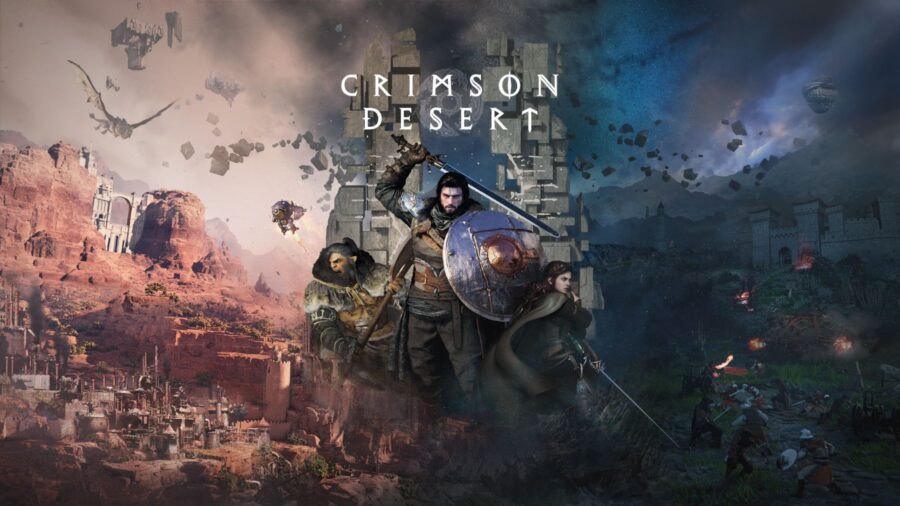
Staged as the most ambitious open world game of 2026, Crimson Desert decided to do only one thing: to collect the best moments of game history under one roof. This big gamble by Pearl Abyss carries the traces of works that have left their mark on the gaming world over the years, while trying to find its own voice. So what does this giant mirror reflect to us? World Design: The Spirit of Skyrim Is Twice the Size As you play the first hours of Crimson Desert, a familiar feeling washes over you: looking down on the valley from a high hill, seeing forest lines flickering in the distance, sensing that a secret is hidden somewhere.
This feeling is a direct legacy of the unparalleled sense of freedom that The Elder Scrolls V: Skyrim has given players for over a decade. But the numbers are striking: Crimson Desert’s map is nearly twice the size of Skyrim. It takes hours to get from one end to the other on a flying mount. The continent of Pywel; It’s full of snowy mountain passes, desert oases, clockwork cities where mechanical beings run farms, and mysterious ruins that hang in the sky.
“I was blown away by the view of the entire map from that high point, reliving that feeling of awe when I first played Skyrim.” – TheGamer, 150 Hour Review The most important lesson learned from Skyrim is the minimalist orientation philosophy. Crimson Desert drops the player into the world rather than picking them up. Fast travel points are not pre-marked; It is opened by discovery. This design decision is a conscious continuation of Skyrim’s “just walk and things happen” spirit.
Combat System: Swinging a Sword in the Shadow of Two Masters Crimson Desert’s combat system is not a copy of a single game; synthesis of skills learned from many masters. This synthesis has two obvious sources: Skyrim’s free weapon diversity and Witcher 3’s warrior identity. Legacy from Skyrim: Weapon Variety and Freedom: Dual swords, sword-shields, two-handed weapons, axes, hammers, pickaxes, bows, and even fists, Crimson Desert’s arsenal continues the Skyrim tradition.
Each weapon has its own feel and rhythm. Just like Skyrim’s Dragonborn, Kliff can choose any combination of weapons and create his own fighting style. There is no traditional XP system either; Skills are learned by exploring and observing NPCs. Legacy from Witcher 3: Warrior’s Spirit and Magic System Kliff’s voice, stance, traveling on horseback and the way he relates to his environment immediately remind you of Geralt.
But the similarity goes deeper: Kliff can use five different elements; Fire, Wind, Ice, Electricity and Nature. This system is a direct extension of Geralt’s five Signs (Aard, Igni, Yrden, Quen, Axii). The wrist armor crossbow and explosive arrows also make clear connections to the Witcher series. GamingBolt states that Crimson Desert brings these different mechanics into a coherent whole, creating a system that is difficult to master but satisfying.
Exploration and Exploration: Red Dead Redemption 2’s Ghosts in Pywel Crimson Desert carries directly the legacy of Red Dead Redemption 2 when it comes to open-world exploration. A Vice review even titled the game to reflect this notion: “The most ambitious open-world game since Red Dead Redemption 2.” Even the physical size of the map is symbolic: Crimson Desert is even larger than Red Dead Redemption 2. But the real similarity is not in size; How discovery rewards.
RDR2’s greatest strength was that it encouraged the player to go astray. Crimson Desert brings the same philosophy to Pywel: discovering a sentient hat tree, encountering the Spirit Knight boss whose defeat unlocks a new weapon ability, deviating from the main quest and entering a completely unexpected story. Weather conditions also continue this legacy: In Crimson Desert, you can sneak up on enemies and neutralize them silently by taking advantage of the shadows on dark and stormy nights.
The School of the Elden Ring: Pain, Patience and Glory Crimson Desert’s boss battles are the game’s most controversial element. And almost all discussions come back to the same reference point: Elden Ring. While describing his encounter with the Staglord boss, a writer from GamesRadar stated that he moved by dodging to learn attack patterns; He emphasizes it just like he would do with a Dark Souls or Elden Ring boss.
Cinematic boss entrances, multi-phase battles (like the three phases of the Reed Field Demon), the need to memorize attack patterns and react at the right moment, these speak the language of Elden Ring. “Even though I tried a boss in Elden Ring for hours, the game does not seem unfair to me. Crimson Desert cannot achieve this balance at some moments.” – TheGamer, Critic Review On the Steam discussion forums, some players describe the game as a “sped-up Elden Ring,” while others liken it to the unevenness of Ninja Gaiden.
One fact is certain: It is useless to enter boss battles unprepared in Crimson Desert. Crimson Desert’s crafting system is one of the richest and most unexpected dimensions of the game. The basic cycle is familiar: go into the forest and cut down trees to get timber; Go into the mine, find mineral deposits, collect metal. This resource-gathering-craft philosophy inherited from Minecraft is implemented in Crimson Desert under the name of the Life Skill system.
Fishing, cooking, farming, mining, animal farm management, dye production, trade, construction; each has its own tools and progression system. When you purchase a Life Tool (fishing rod, axe, pickaxe, etc.), the door to activities in that area is opened. And this system has a direct connection to boss battles: some boss battles are almost impossible to win without crafting enough health items. This connection places the crafting system at the core of the game, rather than being an optional hobby.
What Did It Take From Which Game? Source GameDomainHow Implemented?SkyrimWorld Design The result is a 78 score on Metacritic and a 76 in our review, and with ongoing debate in the community, opinions on the game are a bit mixed. The game is great in its parts, but the whole is sometimes a mess. CGMagazine’s review sums it up nicely: Crimson Desert truly shines when it does its own thing rather than trying to imitate other games.
Perhaps the most accurate description of the game is this: a giant mirror of gaming history and a loudly shouted first draft of the future. This article was prepared based on publicly available game review sources (Game Informer, GamesRadar, TheGamer, Vice, GamingBolt, CGMagazine). Crimson Desert was developed by Pearl Abyss and was released in March 2026.





Comments
You can write your views about this story. Comments may be moderated according to site settings.