
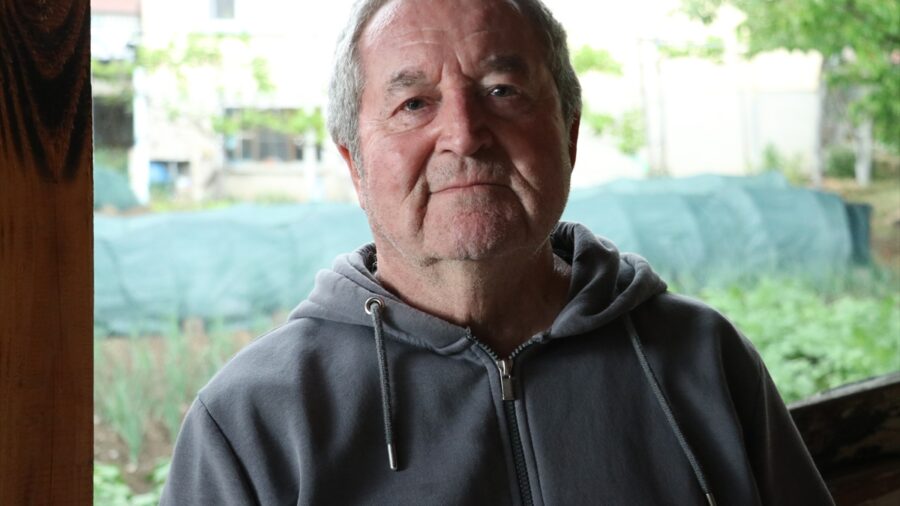
KOŞUKAVAK (AA) – DZHANAN MEHMED ISMAİL – Turks in the country, who opposed the assimilation policy implemented by Bulgaria between 1984-1989, cannot forget the oppression and oppression they experienced despite the passing years. Şükrü Süleyman Mehmed, who worked as a teacher in Koşukavak (Krumovgrad) city in southeastern Bulgaria between 1979 and 1984, told the AA correspondent about his experiences in Belene Camp and the process of coming to Turkey.
Mehmed stated that he practiced his profession with great love and said that in the autumn of 1984, it began to be felt that the pressure on the Turkish minority in Bulgaria would increase. Explaining that they received news that the names of Turks had begun to be forcibly changed in some villages between 1981 and 1984, Mehmed said, “We could not imagine that such a primitive practice would be implemented in an age when technology and communication had developed so much in the late 20th century.” he said.
Mehmed stated that it became completely clear that the Bulgarian administration would start the process of “Bulgarization” by force on the Turks in September 1984 and said, “What we call assimilation is actually Bulgarization by force. In the archives of the Council of Europe, this process is referred to as ‘Bulgarization by force’.” he said. Explaining that there were only 5 teachers of Turkish origin in the school where he worked, Mehmed said that teachers of Bulgarian origin jokingly asked “Have you chosen a name for yourself?” He stated that they asked.
Saying that he reacted very harshly to these words, Mehmed said, “There was a huge argument between us. The school’s party secretary called me to his office and said, ‘You are reacting very violently. This process will be completed at any cost and they will waste you.’ Of course, I could not predict how far they would go.” he said. – “I dropped out of school that day and could never teach in Bulgaria again.” Mehmed stated that the school administration wanted to sign a “petition to change the name” on December 28, 1984, but he did not accept it, and said, “I said, ‘I can’t do this, I can’t live with this shame.
I have no problem with my name, my ethnicity. If my ethnicity will prevent the existence of this country, then I told them to send me away.'” he said. Explaining that the police came to the classroom during the lesson the next day, Mehmed shared his experiences as follows: “There were about 20 minutes before the lesson ended. There was a knock on the door. There were two armed police officers and a civilian officer. They said, ‘You are coming with us.’ So I turned to the students and said, ‘Children, don’t forget this scene.
“Don’t forget what happened during this period,” I said. “I left school that day and could never teach in Bulgaria again.” Mehmed stated that he was subjected to physical violence at the police station after he was detained and said, “Many Turks were arrested in the cities of Kırcaali and Mestanlı that day, and their first referral to Belene was that day.” he said. Explaining that he was interrogated twice during his time in custody, Mehmed continued: “I told them, ‘You don’t need to torture me.
I won’t do what you say. I said, ‘If I am breaking the law, let the court try me and send me to prison because I haven’t changed my name.’ The police chief at that time said to me, ‘I guess you didn’t understand something. There are no laws or courts anymore. ‘Whatever we say will happen,’ he said. Mehmed explained that he was kept under constant pressure after the detention period and that he was called by the police again on January 16, 1985.
Stating that he was offered to be an informant on behalf of the state during the meeting held at the hotel in Kırcaali, Mehmed said, “They asked me to monitor the Turks and give information. “I refused, saying ‘I am a human being and I have honour.'” he said. Mehmed stated that he was taken to the police station again on March 8, 1985 and said, “I entered Belene Camp on March 9, 1985, and left on August 20, 1986.” he said.
-Isolation days in Belene Camp Explaining that he was also subjected to isolation in Belene Camp, Mehmed described the incident he experienced on January 31, 1986 as follows: “One evening, the guard told us to prepare our belongings. We thought we would be sent home. There was such a tradition there, the person leaving would leave the food and belongings he had to his friends. So we gave away everything. The next morning they put us in a vehicle, but after we got a few kilometers away from the camp, an officer stopped us and said, ‘You are not going home, you are being sent to isolation.’ “Then they took us to the 40-person isolation section in the swamp.” Explaining that the conditions in the isolation section are very harsh, Mehmed said that the prisoners held here are not allowed to meet with their families, and the food provided is much worse than those in the main camp.
Mehmed stated that some prisoners started to have health problems due to the bad conditions and said, “They were not giving us sweets, fruit, milk, yoghurt, sugar, anything. We cannot take vitamins. This was another method of torture. Even the eyelashes of some of them started to fall out.” he said. Stating that they started a hunger strike on March 25, 1986 as a reaction to what happened, Mehmed said, “I went on a hunger strike for 14 days.
Some of my friends continued for 18 days. It was a very difficult process, we were only drinking water.” he said. Mehmed explained that he was taken to the large concentration camp again on April 18, 1986, and said that he started a hunger strike for the second time on August 8 and about 20 people joined him. “After 8 days, they asked me to quit the hunger strike. After 5 days, they sent me into exile.” Mehmed said, adding that he stayed in exile in a Bulgarian village for about 27 months.
Mehmed stated that he took care of 140 animals on a farm during his exile period and said, “Exile life was more bearable compared to the concentration camp, so we consider leaving the island where Belene Camp is located and going into exile as salvation, can you imagine?” he said. – “I regained my profession in Turkey” Explaining that he was banned from teaching after he was released and therefore worked in construction, Mehmed said, “We immigrated to Turkey at the end of May 1989 and entered Turkey on June 10.
I regained my profession in Turkey.” he said. Mehmed stated that the effects of the trauma he experienced continued for years and said, “Later, together with my friends, we decided to bring what happened to international platforms. In this context, I worked at the Council of Europe between 2003 and 2013. All of what happened in Bulgaria was transferred to the archives of the Council of Europe.” he said. Stating that they immigrated to Turkey in 1989 and returned to Bulgaria for the first time in 1992, Mehmed said, “The first thing I did was to take back my Turkish name.” he said.
– Assimilation campaign: The communist regime, which came to power in Bulgaria in 1944 with a coup thanks to the siege of the Red Army of the Soviet Union, embraced nationalism when it entered the process of collapse and tried to limit the freedom of ethnic identity, religion, language and culture of Turks and Muslims with the dream of creating a “one nation – one nationality”. The communist elite, which remained in power in Bulgaria for 45 years, directed the heaviest pressure on Turks and Muslims against its political opponents.
With the law passed in 1946, minority schools were closed, and after a while, education in the mother tongue was completely banned. During the period called “Rebirth” or “Return to Ancestry”, which started in the country in 1984, pressure was exerted on Muslims and Turks to change their names to Bulgarian names. Those who opposed this situation were subjected to various pressures such as imprisonment, deportation and being sent to the Belene Concentration Camp on the island on the Danube River.
During the assimilation campaign, while thousands of Turks and Muslims gathered in the squares and participated in protests, dozens of people lost their lives when soldiers opened fire. The world press became aware of the pressures on Turks living in Bulgaria when Olympic and world champion national weightlifter Naim Süleymanoğlu fled to Turkey in 1986. Many states reacted to Bulgaria due to this situation. The Bulgarian administration, which decided to exile the minorities as a result of the reactions, gathered Turks in groups at the Turkish border as of May 24, 1989, and asked Turkey to open the border gates to accept the minority in its country on June 2, 1989.
After Turkey opened the Kapıkule Border Gate on June 4, 1989, approximately 350 thousand Turks left Bulgaria and migrated to Turkey until August 22, 1989.




Comments
You can write your views about this story. Comments may be moderated according to site settings.