
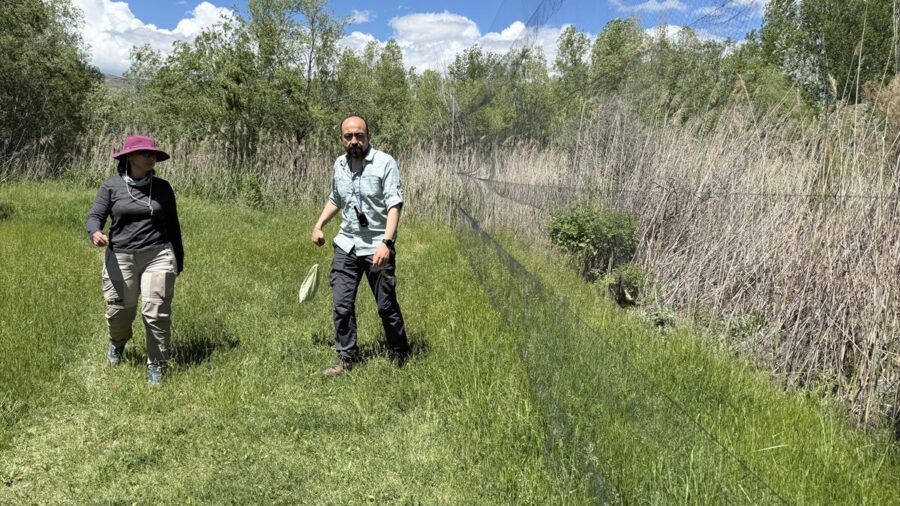
IĞDIR (AA) – HÜSEYİN YILDIZ – In the bird research studies that started on March 10 in Iğdır, 18 birds caught in the nets this year were monitored with a satellite transmitter. Bird research studies carried out by KuzeyDoğa Association in Iğdır with the permission of the General Directorate of Nature Conservation and National Parks (DKMP) continue. At the Aras Bird Research and Training Center established in the Yukarı Çıyrıklı village of Tuzluca district, satellite transmitters are attached to the birds caught in the nets as well as rings.
Satellite transmitters, which are usually attached to intercontinental migrating birds of prey, allow many data to be recorded instantly. Volunteers and scientists at the center monitor the birds by attaching transmitters, the weight of which varies depending on the size of the bird, between the birds’ wings and releasing them back into their natural environment. In the work that started on March 10 this year, satellite transmitters have been installed on 1 falcon, 10 steppe hawks, 2 hawksbills and 5 meadow hawks.
Birds that came from the southern hemisphere and migrated northwards migrated to Kazakhstan after the satellite transmitter was installed. All future migration movements of the birds will be monitored by scientists. – The work has been carried out for 20 years. Aras Bird Research and Training Center station manager Gül Tutar told the AA reporter that they have been working at the center since 2006. Stating that ringing work is the identification of birds in its most basic form, Tutar said, “Actually, we can follow the migration routes of birds, but many different studies can also be done.
One of these is tracking work with satellite transmitters. We can place satellite transmitters on some birds. Some of these transmitters can be 10 grams, some can be 6 grams.” he said. – “Thanks to satellite transmitters, we can track the bird’s current location.” Evaluating the satellite transmitter work this season, Tutar said, “This season, we placed transmitters on 18 birds. This season, we installed satellite transmitters on 1 hawk, 10 steppe hawks, 2 sky hawks and 5 meadow hawks.
Thanks to satellite transmitters, we can track the bird’s current location.” he said. Tutar emphasized that satellite transmitters make a significant contribution to bird research and said: “There is a small solar energy panel on it, so it can send us data. We can access all the information from here, from its speed to its altitude. Many of the birds have now gone to the north of Kazakhstan, they generally prefer this route.
“After going to the breeding or accommodation areas, they continue down to Africa via Türkiye.”





Comments
You can write your views about this story. Comments may be moderated according to site settings.