
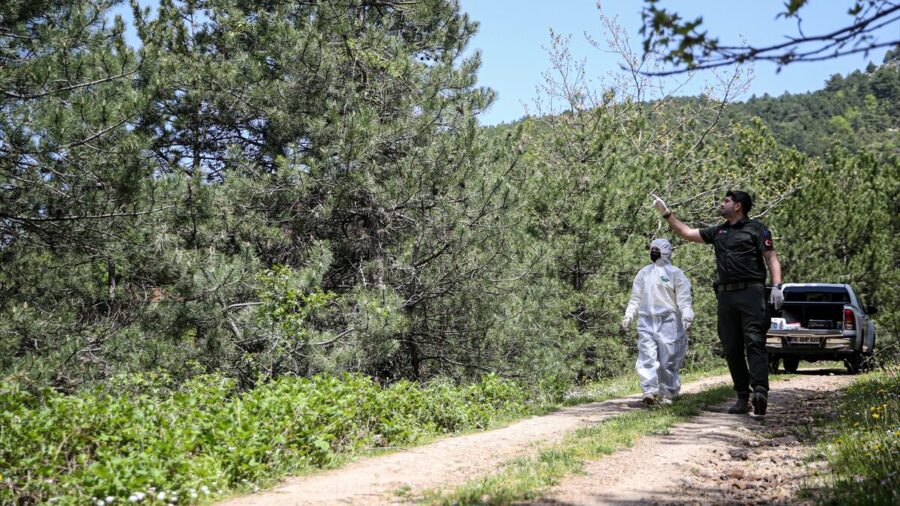
BURSA (AA) – MUSTAFA BİKEÇ – As part of the fight against forest pest pine processionary insects, the “terminator bug” (calosoma sycophanta), which has been produced in the Bursa Regional Directorate of Forestry Biological Control Laboratory for 20 years, is being released into forests all over Turkey. “Terminator insects” have been produced within the Bursa Regional Directorate of Forestry since 2006 in order to combat harmful insects that are described as “smokeless fire” due to the destruction they cause in forests.
These insects, released into areas deemed necessary in forests throughout Türkiye, contribute to the maintenance of natural balance. Bursa Regional Directorate of Forestry Forest Pest Control Branch Manager Bünyamin Arslan told the AA reporter that beneficial insects have been produced in the laboratory within the directorate for 20 years. Stating that the laboratory was renewed in 2018, Arslan explained that the production capacity and insect diversity were increased.
Arslan stated that fight methods compatible with nature are applied in line with the understanding of sustainable forest management and said, “In the work carried out against insect pests, we primarily aim to reduce the population of the pest and to re-establish the disturbed natural balance in the future.” he said. Explaining that pine processionary insects feed on the leaves of pine trees, Arslan noted that trees that cannot perform photosynthesis due to leaf loss become weak and vulnerable to other diseases.
Pointing out that trees may dry out if this pest is not dealt with, Arslan said: “Pine processionary insects are harmful not only to trees but also to human and animal health. Pine processionary insects carry poisonous and hairy structures on their bodies during the caterpillar stage. This structure causes allergic reactions and skin irritation. Let’s warn our citizens about this. These caterpillars and their white sacs should never be touched, especially when picnicking or hiking in areas where pine processionary insects are concentrated.
“Domestic animals should be prevented from eating.” Stating that the calosoma sycophanta species, known as the “terminator bug”, feeds on the larvae of the pine processionary beetle in the food chain in nature, Arslan said that their aim is not to completely destroy the pest, but to preserve the natural balance by reducing its population. – 467 thousand 835 terminator insects were produced in 20 years. Arslan stated that production was carried out in a laboratory environment from the mother insects collected from forest areas in March, and they were released to the bottom of trees in the areas where the pest was seen in the April-May period, and said, “Since 2006, 467 thousand 835 terminator insects were produced in our laboratory and released into the forests where the pest was detected.” he said.
Emphasizing that biological control studies require time and patience and that 27 thousand insects were produced this year, Arslan concluded his words as follows: “We use all biological, biotechnical and mechanical methods together, depending on the density of the pest, in order to obtain effective results without harming biodiversity. We send the insects we produce in our laboratory to all forest areas in Turkey. We send it to Kastamonu, Yalova, Bilecik and other regions where pests are present, in line with need and demand.
“We send an average of 10-15 thousand of the insects we produce to other regions annually.”





Comments
You can write your views about this story. Comments may be moderated according to site settings.